Economics of Clifford Bay vs Picton
Clifford Bay and Picton are projected to cost approximately the same.
Picton’s rebuild delivers a single wharf with no cost savings for ferry operators or customers.
Clifford Bay is a new, multi-user port with capitalised costs savings of $3.6 billion shared by many users. Those savings mean lower user charges which are affordable and can sustain the new port.
The Picton wharf rebuild, with no savings, means either massively higher user charges or write offs for the taxpayer.
Here is the capital expenditure of the two options.
Item | Clifford Bay ($m) | Picton ($m) | Difference ($m) |
Port Works (including share of contingency) | $930m | $751m | $179m |
Marlborough District Council Holdings | $0m | $110m | -$110m |
Taxpayer contribution | $314m | $641m | -$327m |
Sources: Picton costs come from Crown numbers released on 19 November 2025. https://www.beehive.govt.nz/speech/ferry-solution-saves-new-zealand-23b. Port Works include an allocation of project management costs and a contingency.
Clifford Bay costs come from NSX’s Stage 1(a) Market Led Proposal submitted to the Crown on 7 November 2025.
Economic benefits come from the updated study by Cooper and Associates https://www.northsouthexpress.co.nz/post/economic-analysis-benefit-cost-ratio.
The current total asset value of Port of Marlborough including Picton, Waikawa and Havelock ports (before debt) is only $279m https://portmarlborough.co.nz/wp-content/uploads/2025/10/Port-Marlborough-2025-Annual-Report.pdf
Here is a list of other benefits of moving the South Island Ferry Terminal to Clifford Bay.
Safety: Clifford Bay materially reduces safety risks both at sea and on road for ferry users and local communities. Safety report - Clifford Bay vs Picton
No port deals: Government confirmed it has not finalised any deals with either Picton or Wellington ports.
Time savings: Clifford Bay allows a reduction in sailing times of 1-2 hours and up to 1 hour in road trips to and from Christchurch. Travel time to and from Picton will be the same or a little shorter.
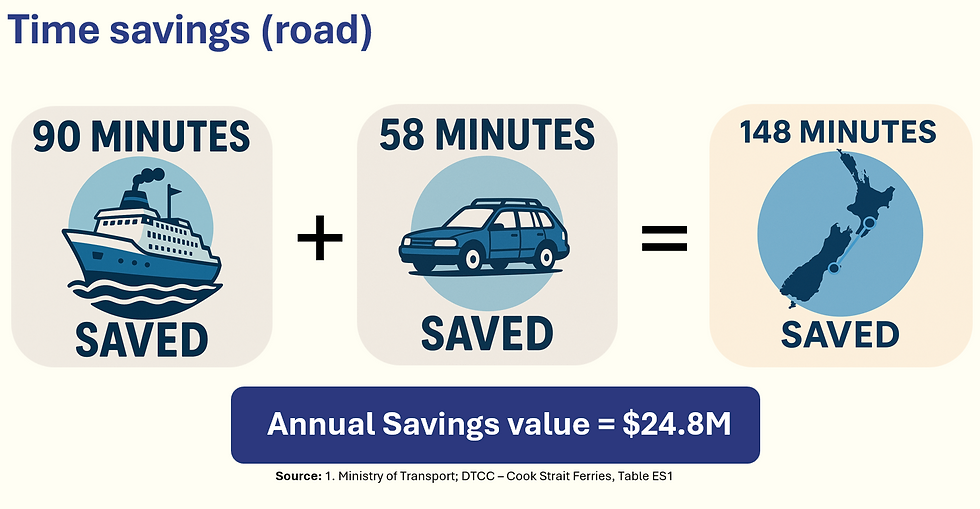
Further cost savings: Clifford Bay more than halves the taxpayer’s contribution to the South Island ferry terminal from $640m to $314m. Taxpayers will take all cost and time risk in Picton. Unlike Picton, Clifford Bay requires nothing from Marlborough ratepayers (although NSX has suggested Council allow Port of Marlborough to use the $110m to take a significant ownership stake in Clifford Bay Port and/or become the operator).
New for old: Clifford Bay delivers a brand-new purpose-built passenger and freight terminal with rapid loading and unloading. The Crown’s proposal for Picton will deliver only “minimum viable product” and does not include replacement of the current temporary terminal (which was only built to operate from mid-2023 till 2031 (at most)). Picton will also be able to be renewed and become a premier destination, not just a bare-minimum SH1 thoroughfare.
National and Regional Benefits: Using Government’s methodology for assessing large scale infrastructure projects, Clifford Bay delivers almost unprecedented net economic benefits 1.7 times greater than the proposed Picton refurbishment, with total net benefits to the New Zealand economy of over $3.6B. Time to be bold!
Rail future: The new larger ferries add complexity and cost to rail operations in Picton. The future of rail will be enhanced by using Clifford Bay.
Ferry operator and customer costs: Both Clifford Bay and Picton propose user charges to cover the substantial capital investment and whole of life costs required. Clifford Bay enables fuel and other savings and efficiencies which exceed those charges. Picton does not. This means Clifford Bay will put much lower upward pressure on charges to passengers and freight operators and much lower lifecycle cost risks on taxpayers and ratepayers.
Scope: NSX’s Clifford Bay proposal is fully scoped – it is unclear if the Crown’s stated costs for Picton include all associated road and rail costs or taxpayer or ratepayer funding of life cycle costs or capital funding from NZTA or KiwiRail.
Lower risks: Clifford Bay enables Picton to continue to serve ferry customers uninterrupted by major construction. Picton will require an aggressive program to meet 2029. Clifford Bay better manages delay and cost overrun risks and eliminates massive construction disruption in Picton. Comparative Analysis
Innovation: Clifford Bay’s new port will incorporate the latest technologies for marshalling vehicles and rail and for passengers. It creates many options for further innovation, new markets and new services which Picton just can’t do. Electrification of heavy transport is a very real example. Fast ferries is another. Coastal container services another.
Process: NSX was invited to use the Government’s market led proposal process on 17 July; lodged its Stage 0 Market Led Proposal for Clifford Bay on 18 August 2025; and lodged its Stage 1(a) proposal on 7 November 2025. It is continuing its engagement with the Crown through that process and is awaiting further feedback in December.